Putting from A to Z
Putting is 43% of the score, which is why it is so important. Although it is the simplest movement in golf, putting lays the foundation for all golf techniques: chipping, pitching, half-swinging and even full swing tee shots with the driver (1 wood). Why is that? Because you’ll develop all the crucial golfing skills more easily and quickly if you learn to putt first. In other words, since the pendulum movement of putting is very simple, you will be able to pay more attention to the skills that are crucial for the future:
- Posture
- Balance
- Rythm and tempo
- Preshot routine and full routine
- Club face stability through the impact zone
- Shoulder turn
- Etc.
No matter what, you will have more fun playing golf and become a better golfer faster if you heed this warning: “Start at the beginning. Start with putting (or pitching with a coach).”
Learn to walk before trying to run
In short, you must learn to walk (putt) before you can learn to run (chip, pitch, etc.). If you don’t, you will have a hard time becoming a good golfer. Even worse, you will fall prey to bad habits if you try to skip steps. However, under the supervision of a golf coach, you can start with pitching and continue with the half-swing and full-swing, even if you have to go back to putting afterwards. Indeed, putting is a world of its own, a swing that is very different from other short game and long game techniques. Putting is a pendulum movement, while other swings are rotational movements. Moreover, the grip in putting is different from the grip of other short and long game techniques.
What exactly is a putt?
A putt consists of rolling the ball on the greens with a putter. However, it is possible to putt around the greens if the grass leading to them is short enough and the surface is flat enough.
To be or not to be right-handed in golf: that is the question.
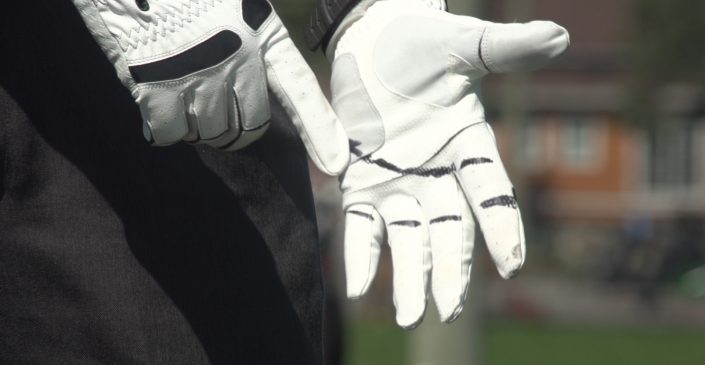
First of all, you must answer the following question: Are you a left or right handed golfer? To answer this question, read the article on this subject. Reading this article is a mandatory step since, with few exceptions, all putters are either left or right handed. However, a small percentage of golfers prefer to putt from the left even though they are right-handed when it comes to other clubs, and vice versa.
Drill: 6″ (15 cm) three ball putt
To learn how to follow-through the ball, practice 6 inches putts with two balls as backswing and foreswing markers. The ball on the trail side of the putter is 6 inches behind the putt. The ball on the lead side of the putter is approximately 6 inches beyond the hole.
6 inches putt with 3 balls
Better to make a pendulum than to hit the ball sharply
0:05 Simple drill to follow-through the ball; 0:12 Backswing twice as short as forward swing; 0:18 Follow-through will transform all your golf techniques.
How to choose the right putter
Choose the putter whose face you can align most easily by the color, shape and alignment lines of the blade. Some people prefer a light blade, but others prefer a dark blade. Some golfers find it easier to align a blade that is shaped perpendicular to the line of sight. Others have an easier time aligning a blade that is elongated away from the target. Finally, the blade may have one or more short or long alignment lines, perpendicular or parallel to the line of sight. It is up to you to try several types of putters at your local golf shop.
Length of the putter shaft
The length of the shaft should allow the hands to fall freely and directly below the shoulders, without bending the elbows. To do this, you need to bend the torso down from the hips. This is the posture I recommend for putting, especially for beginners. Why? Because it simplifies the putting swing and the transition to other golf swings. In fact, many excellent professional golfers, including Phil Mickelson, have adopted short putters for this reason: their arms are extended (no bend in the elbows) as they are for all other golf techniques or swings.
In standard golf sets, this shaft is almost always too long to allow for such a posture. Therefore, you must adopt a more upright posture and/or bend your elbows to make your putts. Otherwise, either lower your hands on the grip or have the shaft shortened by a professional technician. The best thing to do, however, is to get a putter that is the right length and that you like. You can find your ideal putter at your local dealer or golf club pro store.
The 5 static fundamentals: how to set up for a putting stroke. (Description for right-handers, think vice versa if you are left-handed.)
The Socle before any technique
Before trying to fix a swing or a technique, many golfers benefit from clarifying what comes from the mind, the body, and the movement itself.
That is exactly the role of the Mental and Physical Foundation of the Golfer.
A calm, essential step to put things back in order before working on technique.