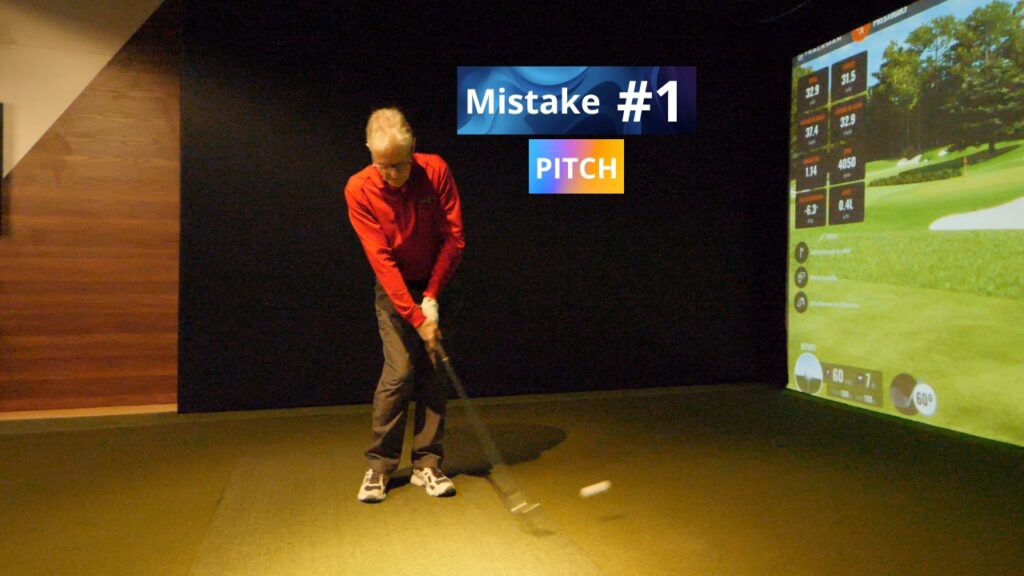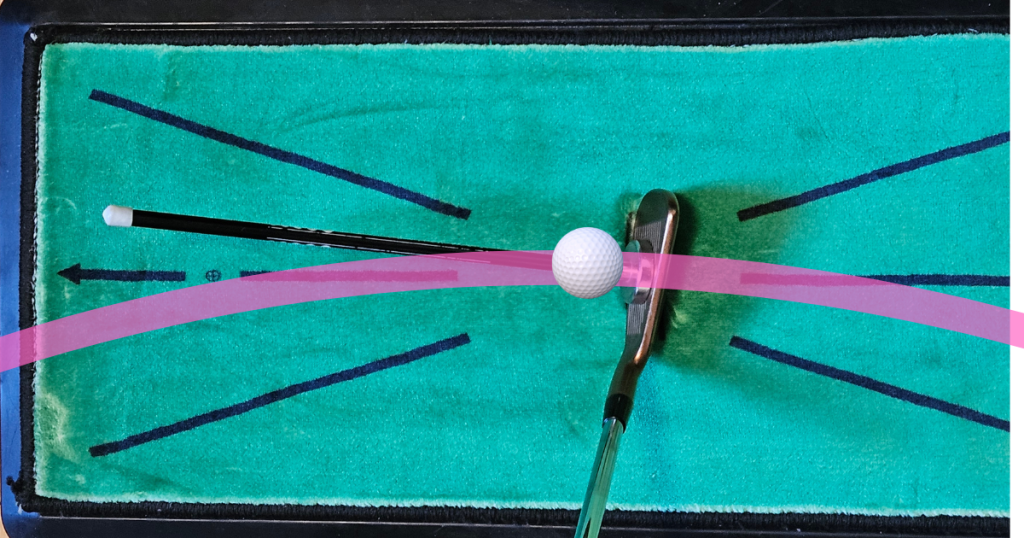
In pitching, one of the most common mistakes is trying to lift the ball.
This intention is understandable.
The ball is on the ground, the target is close, and the player feels they need to help the ball get airborne.
Yet trying to lift the ball is exactly what prevents solid contact.
By attempting to scoop the ball, the player moves their center of gravity backward at impact.
The club slows down, and the low point of the swing shifts behind the ball.
Result: fat shots, thin shots, and unpredictable distances.
Trying to lift the ball on a pitch is like hitting a ball while moving backward.
When you move backward, you eliminate any chance of compression.
Even in the short game, the ball gets airborne because it is compressed against the ground, not because you try to lift it.
A good pitch happens when the weight is clearly forward and the club is moving slightly downward into the ball.
The clubface then does its job on its own.
To correct this mistake: The Flamingo Drill.
The principle is deliberately exaggerated.
Almost all the body weight rests on the lead foot.
The trail foot is lifted and touches the ground only with the tip of the toes.
The trail knee moves in and touches the lead knee.
This position removes any possibility of drifting backward.
It forces the body to stay forward throughout the entire motion.
But be careful: staying forward does not mean staying frozen.
Even in this posture, you must rotate a lot.
And most importantly, you must rotate more toward the target than away from it during the backswing.
Forward rotation is essential.
It allows the club to continue on its natural path without the hands trying to lift the ball.
In this position, the body leads the motion.
The arms follow.
The club strikes downward effortlessly.
The ball gets airborne on its own.
The trajectory becomes more consistent.
Distance control improves quickly.
The purpose of the Flamingo Drill in real play
The Flamingo Drill is not a technique meant to be used during actual play.
But it teaches two fundamental sensations.
Staying forward.
Rotating decisively toward the target.
Sensations the player can later reproduce with both feet on the ground.
Less intention, more body rotation, more ball compression.